Pierre-François De Plaen
PhD Researcher in Computer Vision · KU Leuven
I am a final-year PhD researcher in computer vision at KU Leuven, supervised by Profs. Luc Van Gool, Marc Proesmans, and Tinne Tuytelaars within the TRACE lab. I am interested in building systems that can act in the physical world, spanning logistics, autonomous driving, and construction. This requires models that truly understand their environment: combining strong perception, spatiotemporal and causal reasoning, persistent memory, and long-horizon planning. Such models would anticipate how a scene will evolve and the consequences of their own actions. I believe unsupervised learning is the right path to achieve this at scale, and my PhD built the representation learning foundations for it: I designed self-supervised training objectives, built instance-level video representations, and developed a theoretically grounded approach to minimize feature redundancy.
Publications
-
Preprint 2026
Self-Supervised Learning with a Multi-Task Latent Space Objective
We unlock stable multi-crop training for self-predictive SSL methods and reframe SSL as a multi-task problem where each spatial transformation defines its own latent-space alignment task, achieving SOTA on ImageNet with ResNet-50 and ViT-B. We propose a multi-task formulation of self-predictive Siamese SSL in which each spatial transformation defines a distinct latent-space alignment task, solved by a dedicated predictor over a shared encoder. This perspective directly explains a long-standing failure of multi-crop training in self-predictive methods such as BYOL, SimSiam, and MoCo v3: a shared predictor is forced to solve heterogeneous alignment tasks simultaneously, leading to unstable optimization. Assigning one predictor per view type resolves this interference, unlocking linear evaluation gains of 3.8–4% across frameworks. This perspective also suggests a principled way to enrich pre-training by introducing additional spatial transformations as complementary tasks. We demonstrate this by introducing asymmetric cutout views, in which a masked online view is aligned with a complete target, forming a semantic inpainting objective. The resulting framework is stable, backbone-agnostic, and consistently improves the performance of ResNet and ViT models on ImageNet and COCO. -
Preprint 2026
Adversarial Dependence Minimization
We introduce an adversarial algorithm that provably achieves mutual statistical independence across embedding dimensions, providing a principled foundation for redundancy minimization. Minimally redundant representations are typically learned by minimizing feature covariance. However, covariance-based methods fail to eliminate all dependencies and redundancies, as linearly uncorrelated variables can still exhibit nonlinear relationships. To address this, we introduce ADM, a differentiable algorithm that minimizes statistical dependence between feature dimensions through an adversarial game: auxiliary networks identify dependencies, while the encoder removes them. We prove that mutual independence is achieved at the global optimum, empirically verify convergence, and study three potential applications: extending PCA to nonlinear decorrelation, improving generalization in image classification, and preventing dimensional collapse in self-supervised learning. By promoting statistically independent representations, ADM paves the way for learning more robust, compressed, and generalizable representations across diverse applications. -
WACV 2024
Contrastive Learning for Multi-Object Tracking with Transformers
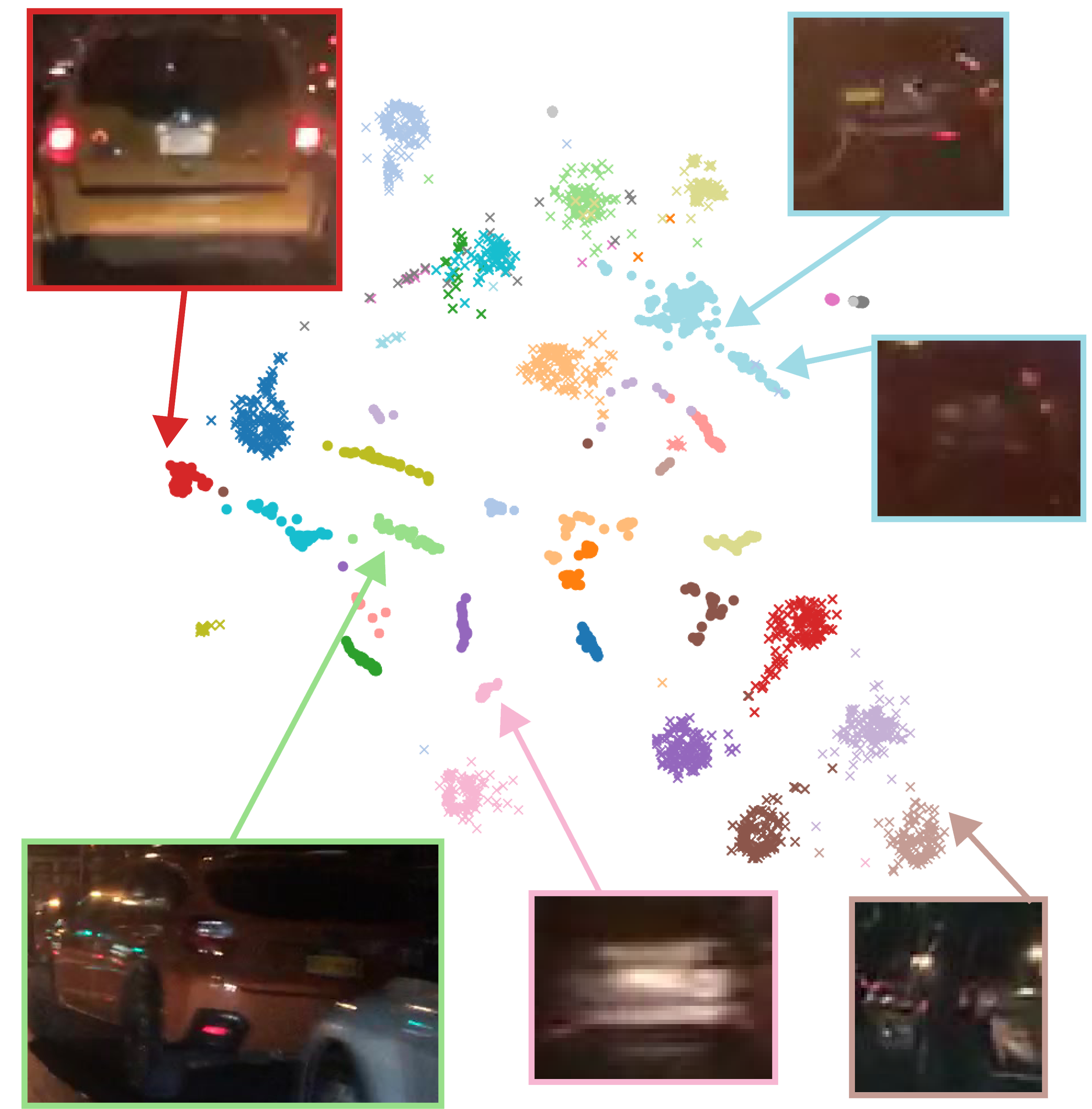
We turn DETR into a multi-object tracker using a contrastive instance loss and a lightweight assignment method, achieving SOTA on BDD100K with a pre-training scheme that requires no tracking annotations. The DEtection TRansformer (DETR) opened new possibilities for object detection by modeling it as a translation task: converting image features into object-level representations. Previous works typically add expensive modules to DETR to perform Multi-Object Tracking (MOT), resulting in more complicated architectures. We instead show how DETR can be turned into a MOT model by employing an instance-level contrastive loss, a revised sampling strategy and a lightweight assignment method. Our training scheme learns object appearances while preserving detection capabilities and with little overhead. Its performance surpasses the previous state-of-the-art by +2.6 mMOTA on the challenging BDD100K dataset and is comparable to existing transformer-based methods on the MOT17 dataset. -
CVPR 2023
Unbalanced Optimal Transport: A Unified Framework for Object Detection
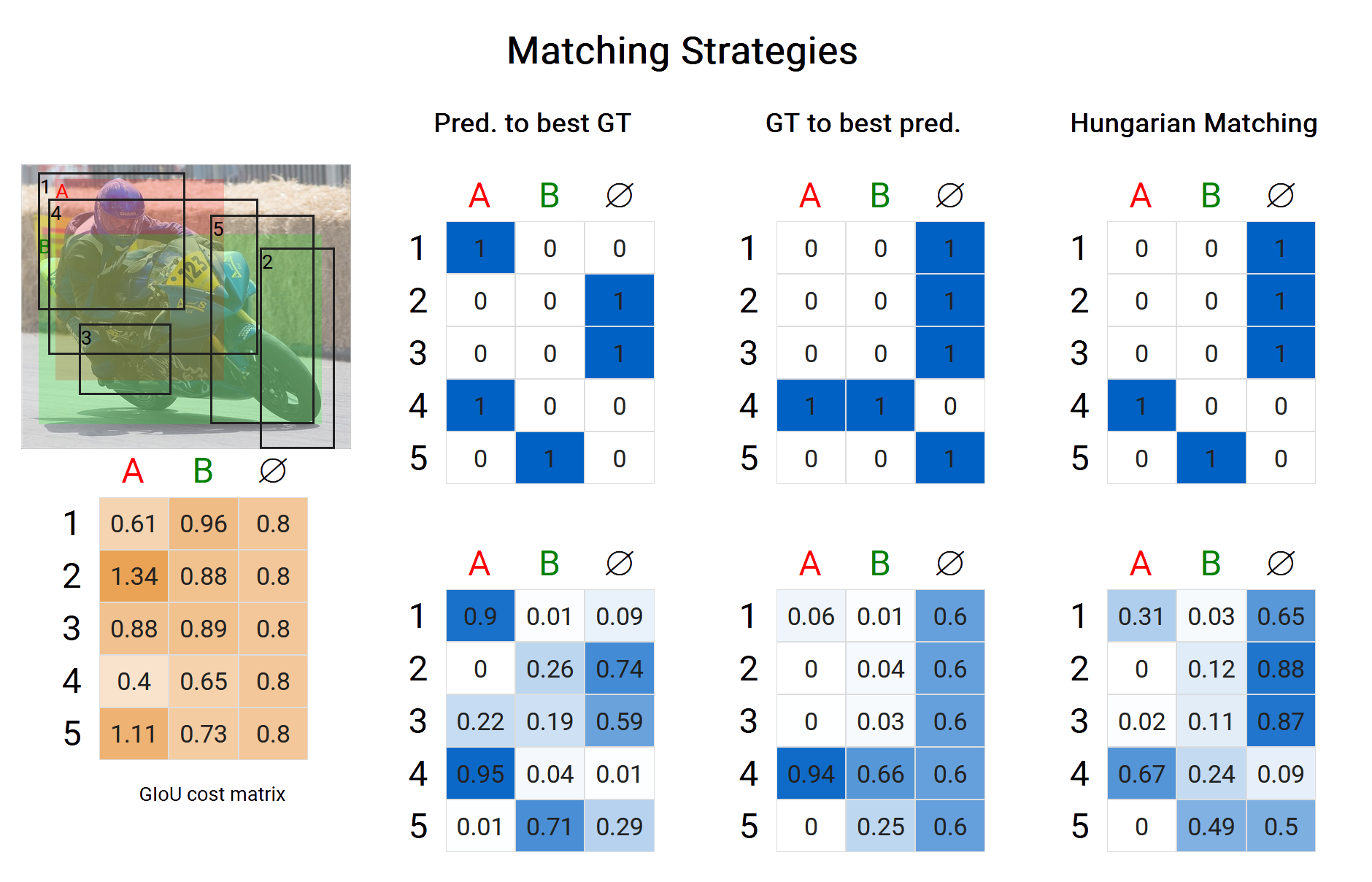
We show that Unbalanced Optimal Transport unifies anchor-based and anchor-free object detection matching strategies into a single GPU-friendly continuum, with an open-source CUDA implementation of the Sinkhorn algorithm. During training, supervised object detection tries to correctly match the predicted bounding boxes and associated classification scores to the ground truth. This is essential to determine which predictions are to be pushed towards which solutions, or to be discarded. Popular matching strategies include matching to the closest ground truth box (mostly used in combination with anchors), or matching via the Hungarian algorithm (mostly used in anchor-free methods). Each of these strategies comes with its own properties, underlying losses, and heuristics. We show how Unbalanced Optimal Transport unifies these different approaches and opens a whole continuum of methods in between. This allows for a finer selection of the desired properties. Experimentally, we show that training an object detection model with Unbalanced Optimal Transport is able to reach the state-of-the-art both in terms of Average Precision and Average Recall as well as to provide a faster initial convergence. The approach is well suited for GPU implementation, which proves to be an advantage for large-scale models.
Curriculum Vitae
-
Education
-
PhD Electrical Engineering, Computer Vision
2021 – presentDepartment of Electrical Engineering, KU Leuven · Leuven, Belgium
- Supervised by Prof. Luc Van Gool, Prof. Tinne Tuytelaars, and Prof. Marc Proesmans.
- Research focus: self-supervised learning, spatio-temporal representation learning, deep learning theory.
- Published first-author research at top-tier venues (CVPR, WACV); secured a 20,000 GPU-hour grant from the Vlaams Supercomputer Centrum (VSC).
- Reviewer for CVPR, ECCV, NeurIPS, ICLR, ICML.
- Teaching Assistant for the Master's course "Image Analysis and Understanding".
-
MSc Mathematical Engineering, focus on Machine Learning
2019 – 2021Ecole Polytechnique de Louvain, UCLouvain · Louvain-la-Neuve, Belgium
- Master thesis: "Semi-Supervised graph node classification using CNN-based algorithms" (Magna cum Laude).
-
BSc Engineering, major in Applied Mathematics, minor in Electricity
2016 – 2019Ecole Polytechnique de Louvain, UCLouvain · Louvain-la-Neuve, Belgium
-
-
Awards
-
VISUM Summer School
2022- Led a team to a top-3 finish in the Barcode Recognition Challenge.
-
Science-Expo
2016- Second prize in mathematics; presented at Encuentro de Jóvenes Investigadores, Spain.
- Best bilingualism presentation prize.
-
Centre Scolaire Saint-Michel
2016- Special Honors for work and initiative as Class Representative.
-
-
Technical Skills
- Programming Python, C++, MATLAB, PHP, Java, C
- ML Frameworks PyTorch, TensorFlow 2
- Software & Tools Linux, Git, LaTeX, CUDA, Weights & Biases, Adobe Suite
- Mathematics Optimization, Matrix Theory, Probability & Statistics
-
Languages
- French Native
- English Fluent
- Dutch Fluent in reading and writing
- Japanese Notions
-
Other Experience
-
Climbing Instructor
2014 – 2023- Certified Climbing Instructor at Evolution Verticale (Brussels) and Entre Ciel et Terre (Louvain-la-Neuve), Belgium.
-
Website Project
2016- Suggested and created a website for Centre Scolaire Saint-Michel (Belgium) to support students reselling second-hand books within the school community (1,500+ students).
-